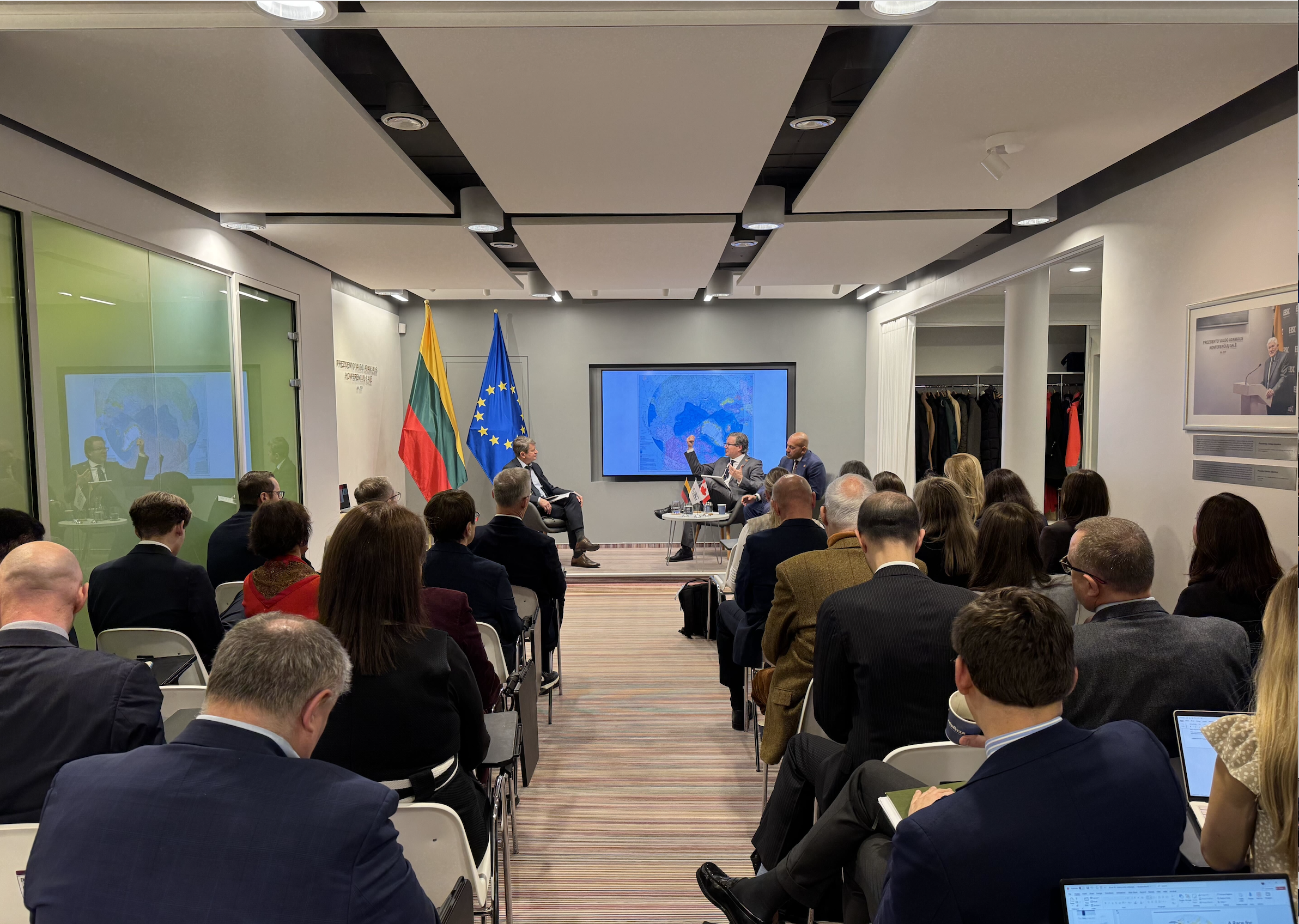
Summary of the discussion held at Geopolitics and Security Studies Center, Vilnius, Lithuania on October 19, 2026
Geopolitical and Strategic Developments
The Arctic remains a region of growing strategic importance, particularly as changing environmental conditions create new opportunities and challenges for regional and global actors.
The discussion distinguished between two interconnected dimensions of Arctic security: threats originating from or passing through the region that could affect other parts of the world, and threats directed at the Arctic itself, including its infrastructure, communities and economic activities.
Russia’s military presence in the Arctic, particularly on the Kola Peninsula, was identified as an important factor shaping the regional security environment.
The accession of Finland and Sweden to NATO has strengthened the Alliance’s collective defence and deterrence posture in the European High North.
Climate Change and Infrastructure
Climate change is transforming the Arctic’s physical environment, influencing accessibility, connectivity and navigation, infrastructure requirements and economic opportunities. However, the discussion emphasised that the opening of new maritime routes does not automatically translate into their immediate commercial viability.
Infrastructure development was identified as an important component of Arctic security and resilience. Investments in transportation networks, critical mineral mining, and energy infrastructure can support both civilian needs and national defence objectives.
Icebreakers were highlighted as particularly important assets for ensuring maritime accessibility and increased connectivity, supporting scientific research, maintaining supply routes and improving situational awareness.
The discussion also addressed Canada’s efforts to strengthen infrastructure and operational capabilities in its northern territories.
Economic Security and Foreign Investment
Economic security emerged as another important dimension of Arctic security, particularly regarding foreign investment in strategic resources, critical minerals and infrastructure.
Participants discussed the potential security implications of foreign, at times unfriendly or openly hostile economic involvement, including investments linked to China, and the need to screen such activities in the light of broader geopolitical developments.
Canada’s regulatory mechanisms, including national security screening of foreign investments, were highlighted as tools for managing potential vulnerabilities while maintaining economic openness and international trade relations.
Hybrid Threats and Political Resilience
The discussion examined the growing relevance of hybrid threats, including disinformation, foreign interference, cyber threats and attempts to exploit political and societal divisions.
Participants highlighted that domestic political polarisation and challenges to alliance cohesion can undermine collective security and resilience. Maintaining public trust, strengthening institutional preparedness and protecting democratic processes were therefore identified as important elements of a comprehensive security approach.
The importance of international cooperation and effective strategic communication was also emphasised, particularly in responding to activities intended to weaken political unity.
Canada’s Northern Communities and Indigenous Engagement
The discussion addressed the role of Canada’s northern communities and Indigenous peoples in shaping Arctic policy and development.
Participants highlighted the importance of involving local communities and Indigenous representatives in decisions concerning infrastructure, economic development and security.
The discussion also considered the relationship between national defence investments, regional economic opportunities and the long-term resilience of northern communities. It was stressed that hostile actors use full spectrum of GIMI instruments to affect the said populations and communities, thus having a bigger bearing on national policies.
Key Messages from the Discussion
Several overarching messages emerged from the discussion:
- Arctic security is closely connected to broader transatlantic security developments. Regional challenges should therefore be considered within a wider strategic context.
- NATO unity and coordination remain essential for strengthening collective defence, deterrence and stability in the High North.
- Strategic infrastructure investments are increasingly important, particularly in dual-use capabilities, transportation networks, icebreaking capacity.
- Both satellite systems and ICBMS usually pass the polar circle, hence there is a need to be able to track them especially meticulously.
- Economic security requires careful assessment of foreign investment risks, especially in critical infrastructure and strategic resources.
- Resilience against hybrid threats depends on strong institutions, societal cohesion and effective cooperation of like-minded nations.
- Local communities and Indigenous peoples play an essential role in ensuring that regional development contributes to long-term stability and resilience.